

With a measuring tape and waterproof notepad in hand, Shellie Baxter swims around a shipwreck embedded into the ocean's floor in the Florida Keys. The water is warmer than the San Diego shores she's used to, but this is still her most challenging dive yet – she is learning how to document slave shipwrecks.
As a genealogist, Baxter has helped over 150 people trace their ancestral roots through her organization Our Genetic Legacy, a non-profit committed to uncovering the hidden histories Black and Indigenous people.
"Our end goal here is to do archeological research underwater to help find sunken slave ships and document them." Baxter said, looking at the ocean.
"And it's a whole 'nother level of diving. You're taking measurements, writing them down underwater, and then coming back up and creating schematic drawings so that they can create a recreation of that shipwreck."
Ship wrecks are etched into Florida's southern coasts. One of the most infamous is the Henrietta Marie, a slave ship that sold 200 people into slavery in Jamaica. On its way back to Britain, the vessel was eventually swallowed up in the New Ground Reef.
Today a memorial in the Florida Keys honors those that were held captive on this ship.
But most slave ship wrecks remain uncovered on the coast. Historians estimate that as many as 1,000 ships sank during the Middle Passage, but fewer than 20 of these wrecks have been documented.
Within that 400 year period of the transatlantic slave trade, an estimated 2 million African captives died at sea– drowned, murdered, tortured, or generally lost to history.
Diving With a Purpose, an underwater archeology program committed to uncovering these slave shipwrecks, encouraged Baxter to start diving for history.
"I was so scared, I'm not going to lie. Going underwater, you can't breathe there," Baxter said.


At 54, Baxter completed her first dive. Even though she grew up by the ocean in San Diego, she had a complicated relationship with the water.
"When I was about eight or nine years old, I went swimming with my school and I almost drowned," Baxter said, leaning forward.
Drowning death rates for Black and Indigenous children in the U.S. are disproportionately higher than white children. For Black children many of these deaths happen at public pools, similar to Baxter's almost fatal case.
These higher rates of drowning are a side effect of a few factors, including a lack of access to swimming classes and pools, historical exclusion, and a passed down "fear of drowning".
Despite Baxter's childhood experience, diving has been life-altering, symbolically reminding her of own survival.
"When you're actually doing it, and surviving it, it's just empowering. It's a whole nother world underwater," Baxter told WLRN.
"And it was just really exciting to be with so many Black and brown long-term divers [at Diving With a Purpose] and teachers. And the way that they were sharing, not just with the youth, but with me, as an adult coming into this late."
Within the past two years, Baxter has completed over 40 dives and is committed to sharing this knowledge with Black women and girls who are curious about their history.
"Being able to get my hands dirty, or wet in this case," Angeni Nettles, 24, said sitting next to Baxter by the ocean, "Made this history a lot easier to digest."
READ MORE: We cannot be afraid': Black leaders rail against new African American history standards
Nearby sat Alana Lara, 16, the youngest diver in the group.
"I didn't like history," Lara added, "But I realized how much more there is to the world that we don't know. Even how history can repeat itself. If we learn from the past and see mistakes, we can maybe make it right in the future"
Lara is part of a new cohort of young divers in Baxter's organization called the UnderH20 Explorers— a free program targeted towards girls of color.
As they learn how to dive, they are also unearthing the history behind slave shipwrecks on Florida's coasts.
"The stigma that Black people don't dive is always there," Rollins said, "But, I'm an adventure seeker."

Pushing past gaps in historical records
Within the past two years of diving, Baxter has hopes that her underwater work can fill the gaps that are in so many historical records, especially for Black Americans whose family lines have been severed by slavery.
"There's a thing called the brick wall of 1865, because before emancipation, we were not listed as people in government documents. We were only listed as property in insurance documents, slave rosters, and wills." Baxter said, "But those documents only list people by gender and age, not by name."
Before 1865, only two censuses included what was known as a "slave schedule"; a record that documented the first and last name of enslavers, but only the age, sex, and color of the enslaved. The 1870 census was the first time that Black Americans were recorded by name.
Much of Baxter's genealogical work focuses on pushing past this barrier in historical records.
"The goal is to find your oldest traceable ancestor pre-1865. So when you're able to cross that barrier, then you can start to get some of that family tree." Baxter said. "So many people think it's not possible to figure it out. They think that even DNA [tracing] isn't going to be enough"
Until recently, most of Baxter's genealogical work has been on land. She uses a process called Legacy Tracing to find family lines that appear to be "uncoverable" by combining DNA analysis, historical records, and technologies such as LiDAR mapping to map out cemeteries.
But some stories still remain beyond the reach of historical documents.
"What if part of your family didn't survive to become part of a data set?" Baxter said, "Then it's not going to show up."
For the millions that died at sea during the Middle Passage, there are no gravesites for Baxter to map out and often, there are few historical documents for her to reference.

The bigger picture
Because of these gaps, Baxter believes that it is equally important for families to learn about the larger historical context that shaped the lives of their ancestors.
"We need to learn about what was happening in that place at that time." Baxter said, gathering her diving gear, "What were the powers that be?"
That work has culminated into Baxter's latest project, a history book called We the People.
"Our ultimate goal is to write the first US history book written by the BIPOC descendants of those who built the Americas." Baxter told WLRN.
" So often history's been told from the white male lens, and others have just been discarded."
The forthcoming book will tell American history through the lives of everyday people, especially those whose stories have often been left out of traditional textbooks.
For the young women that Baxter mentors, diving has become a new way to engage with this history.
"I had a fear of history because of all of the hurt that was in it for Black people. But being in the water has helped," Nettles said, looking over at Baxter.
"We were at the site of the Guerrero and we were looking for the debris. It was still so impactful being to be like, 'I'm here breathing in this water where this tragedy took place.'"
The Guerrero was a pirate slave ship that was bound for Cuba with 561 captive Africans on board. The vessel eventually wrecked on a reef in the Florida Keys in 1827, drowning forty-one people, while the surviving captives were sold into slavery in Cuba.
The site off of Key Largo has not been formally documented as the location of the Guerrero shipwreck, but archaeologists have reason to think it is.
"This is the only site that matches everything we know about the Guerrero." Corey Malcom, Director of Archaeology at the Mel Fisher Maritime Museum in Key West, told WLRN.
"The location, artifacts, the dates of everything— it all fits perfectly with the historical record and there is nothing else that matches."


The beauty of survival
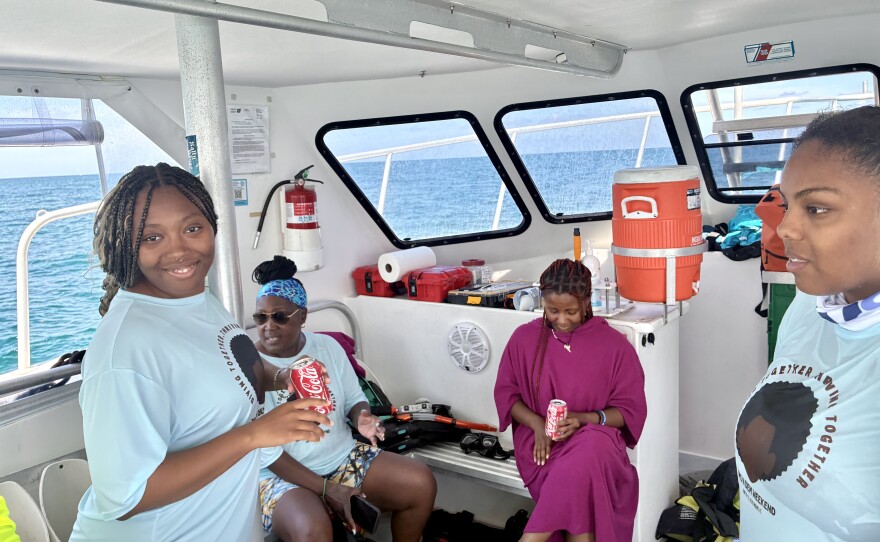
Being able to dive at this site was deeply moving for these young divers, especially Marlynn Rollins, who joined Baxter's program at 28 years old. For her, diving has been a therapeutic experience.
"When I dive, I don't have all that background noise going on in my brain." Rollin told WLRN, "I'm also a spiritual person, so I left like when I looked at all the wildlife down there, I feel like God is down there.'"
For Baxter this is the beauty of uncovering your history; understanding the impact of historical struggle and yet remembering the miracle of survival.
"Often, Black and Brown folk hear about the tragedy and trauma. We don't hear anything about the resilience, the triumph." Baxter said, preparing herself to go on another dive.
As a ship docked on the shore, Baxter gathered her young divers together. They prepared themselves to go back out to sea for their last dive in Florida's warm waters.
"When you're looking at documents and you put names to those ancestors,"Baxter said, "It just increases that understanding, and allows you to be able to see that the strength that they had to survive is in you."
Copyright 2026 WLRN