

Big money flows through political races — from county commissioners all the way up to the presidency. Each election cycle, PACs collect billions of dollars nationwide.
Political committees are groups of two or more people, or organizations or clubs. They can raise and spend money to support or oppose candidates or ballot issues.
Common types include traditional political action committees and super PACs.
Transparency USA, a nonpartisan organization that tracks state-level campaign finance data, reports more than $660 million has been donated to Florida’s state races for the midterms.
Money raised pays for candidates to travel, advertise, hold events, and more.
Florida's major-party nominees for governor each have two traditional PACs — a candidate committee and an affiliated committee. One limits how much corporations and individuals can donate; the other doesn't. And both candidates have brought in a lot of money for the midterms.

Candidate Committees
Florida law strictly governs candidate committees. For statewide races, like the governor’s, individual contributions cannot exceed $3,000.
Aubrey Jewett is a political science expert at the University of Central Florida. He said the courts capped that amount so people had faith in elections and their elected officials.
"We don't want the average American to think that their politicians are for sale to the highest bidder," Jewett said.
There's always been money in politics. But Jewett said elections used to be more like a boxing match.
"You have one candidate against the other, and they're in the ring. There's at least a few rules, they've each raised money, and they're duking it out, and one of them is going to win," he said. "Now it's sort of like this giant free-for-all mud wrestling extravaganza."
While both of Florida's major party gubernatorial candidates have raised substantial cash, Jewett said the real money is in affiliated PACs.
Affiliated PACs
When it comes to affiliated PACs, "no limit exists on the amount that can be contributed to a political committee," according to the Florida Division of Elections.
Jewett said having no limits is a huge loophole for candidates.
"You can give however much money you want," he said. "Like in Florida, the biggest donor to the biggest affiliated PAC is a $10 million donation by one person.”
The biggest affiliated PAC in Florida is Friends of Byron Donalds — the Trump-endorsed Republican candidate for governor. As of Sept. 7, that committee raised more than $100 million. Billionaire Kenneth Griffin, CEO of the hedge fund company Citadel, made the largest single donation to it.
Griffin has dumped more than a quarter billion dollars into political races across the U.S. since 2022. The Wall Street Journal reported in July he invested $40 million into the midterms, which could double by November.

“The people of Florida deserve leaders who wake up every day thinking about how to make their lives better — safer streets, stronger schools, and the freedom to build a future for their families. Byron Donalds cares deeply about the families and communities that make Florida the greatest state in the nation, and I am proud to support him as our next Governor. Floridians will be well served by his leadership,” Griffin said in a statement to WUSF.
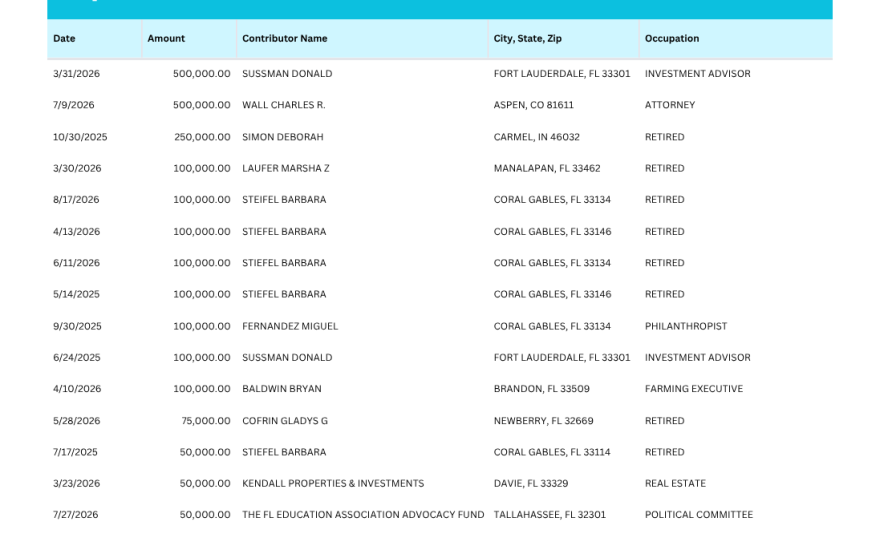
As of Sept. 7, Jolly's affiliated PAC, Florida 2026, raised nearly $6 million. And he has his own share of big-money donors.
Two donated more than a quarter of the total amount — like millionaire and hedge fund manager Donald Sussman, who donated $600,000, and attorney Charles Wall, who donated $525,000. Wall was general counsel for the Altria Group, the parent company of tobacco giant Philip Morris International.
Still, Jolly said he is running a different kind of campaign than Donalds.
"I'm happy to meet with anybody that represents interests across the state of Florida, but they're not going to buy their way in," Jolly said at a press conference in response to a question by WUSF. "So we have turned down a number of offers of contributions, financial contributions from interests and industries within the state."
His opponent, Donalds, however, may not have turned down financial contributions. Special interest groups tied to sports betting, data centers, and developers have donated millions to his campaign.
Billionaires like Griffin have poured a lot of money into his affiliated PAC as well, including Pennsylvania-based Jeff Yass, who donated $7.5 million. But that's not all. Yass also donated $3.5 million to the super PAC, Club for Growth Action Florida. That PAC gave Friends of Byron Donalds $3.75 million, bringing Yass' contributions to Donalds to $11 million.
WUSF reached out to Jeff Yass for comment and did not get a response.
Since 2017, Yass has spent more than $75 million on elections in his state. There's even an online tracker tool called All Eyes on Yass to follow his donations.
WUSF reached out to Byron Donalds' campaign and did not receive a response.
Super PACs
A super PAC is considered an independent expenditure committee. That means unlike traditional PACs, they cannot coordinate with the candidates they support. They can also raise and spend unlimited amounts of money.
However, the 2010 United States Supreme Court decision in Citizens United v. FEC (Federal Election Commission) opened the door to unlimited corporate spending on political advertisements and essentially treated corporations as people.
"This Court now concludes that independent expenditures, including those made by corporations, do not give rise to corruption or the appearance of corruption. That speakers may have influence over or access to elected officials does not mean that those officials are corrupt. And the appearance of influence or access will not cause the electorate to lose faith in this democracy," justices wrote in the 2010 Citizens United decision.
But Joedy McCreary is a senior reporter with OpenSecrets, a watchdog group on government accountability. He said when people give these million-dollar-plus donations, they're not giving it away for nothing.
"They want something, so whether that's proximity to a political figure, whether that's influence, (or) whether it's specific policy outcomes," McCreary said.
But Citizens United didn't directly create super PACs. Another case, SpeechNow v. FEC, decided in an appeals court, used the logic of Citizens United to strike down limits to individual contributions to super PACs, opening the floodgates on political spending.
"(It) did a lot of the same stuff. It knocked down a lot of those obstacles to corporations. And when I say corporations, not just companies, but also nonprofit organizations,” McCreary said.
And both of those cases ushered in the era of dark money.
Dark money
While traditional PACs and super PACs are transparent because they must disclose their donors, groups found a loophole: they donated large amounts anonymously to candidates and ballot measures through nonprofits labeled as 501(c)(4)s.
"These folks can take unlimited contributions from anyone. George Soros, thank you for your $2 billion. Koch Brothers, thank you for your $3 billion," Wayne Garcia said. "They're called dark money because the money that comes into them, we have no way of following that money trail any longer."
For the last three decades, Garcia has worked in colleges, Florida newspapers, and political campaigns.
He said 501(c)(4)s are supposed to educate the public. The IRS calls them “social welfare organizations.”
And they’re not like normal nonprofits — these groups can lobby, take part in campaign activities, and donate unlimited amounts in elections. Garcia says the big difference is billionaires can anonymously give millions to dark money groups, and then that nonprofit can donate whatever and wherever — leaving no trace.
"You have a way to launder your money into politics that does not have your fingerprints on it any longer, because you give it to the you know 501(c)(4) and you don't have to, they don't have to report anything," he said.
Local races get PAC money too
PACs don't just donate to state and federal races, they play a role in local politics too.
Democrat Stephanie Vazquez is running for Pasco County Commissioner in District 2. She’s a first-time candidate.
“PAC money and corporate money absolutely flows down to the local level and in massive quantities," Vazquez said. "I believe it truly influences how people govern and make decisions when they're elected.”
PACs can only donate up to $1,000 at the county level. But there’s a loophole there too. Vazquez said the PACS could give her the money outright.
“Or they could just send out $20,000 worth of mailers supporting my campaign," she said. "And so it doesn't ever hit my contribution report."
Vazquez has raised about $60,000 and has taken money from two PACs - a labor union and Ruth’s List of Florida, which supports Democratic women running for office. Compared to her Republican opponent Seth Weightman, who’s raised more than double her amount.
On one day in March, Weightman got $10,000 from 10 PACs that share two addresses in Gainesville and Tallahassee.
WUSF reached out to Weightman about the contributions and did not receive a response.
Political advertising from PACs
Sometimes, candidates pay for political advertisements themselves. Other times, political action committees pay for them.
Like one of Byron Donalds' recent ads, Agenda, paid for by his affiliated committee.
PACs influence elections at all levels. It's why Open Secrets reporter Joedy McCreary said political advertising is designed to conceal the true identity of who’s really paying for the messages.
“Be aware that there are dark money groups out there that we don't know who's funding them that are donating to super PACs that are then spending on ads that you see on TV and on Facebook and wherever,” he said.
AdImpact projects more than $11.5 billion will be spent on political ads this election cycle nationwide — making it the most expensive on record.
And nearly $60 million of that will advertise Florida’s race for governor.
If you have any questions about state government or the legislative process, you can ask the Your Florida team by clicking here.
This story was produced by WUSF as part of a statewide journalism initiative funded by the Corporation for Public Broadcasting.
